Shame
Being and NothingnessShame names the immediate recognition of oneself as an object for another person: not merely a judgment about a deed, but an experience in which the other’s gaze reveals a dimension of one’s being that cannot be possessed or established from within. Its decisive significance is relational. Shame shows that a person’s being is not exhausted by the first-person life of consciousness; the other makes that person appear as someone with an outside, exposed to meanings and judgments that remain beyond their control.
Structure and occasion
Shame is intentional and non-positional: consciousness lives itself as shame without first taking itself as an object of reflection. It is accessible to reflection afterward, but reflection does not produce its primary form. The experience concerns the self, yet it arises fundamentally before somebody. Its structure thus joins an intimate relation to oneself with the presence of another person.
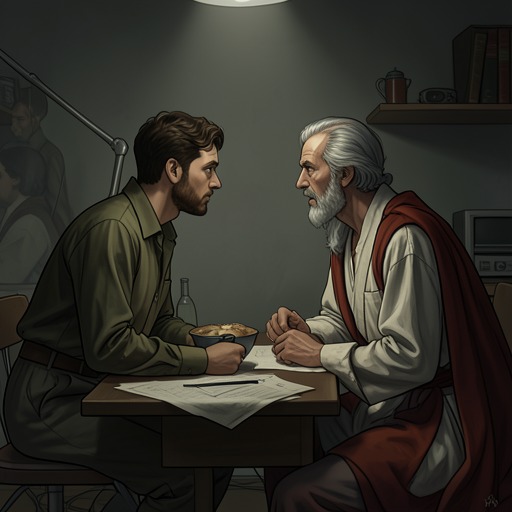
The example begins with an awkward or vulgar gesture. The person lives the gesture without judging or blaming it. Then the person raises their head and discovers that someone has seen. The gesture suddenly appears as vulgar, and shame follows. This change is not the outcome of a private comparison or a considered verdict. It is an immediate bodily shudder, a recognition precipitated by the witness. The other mediates the person’s relation to themself: the person becomes ashamed of themself as they appear to the other.
The witness is not simply a private image that the person could dismiss as an inaccurate portrait. If the other’s view were only an image produced inside the other, it would belong wholly to that other and could not touch the person so directly. Shame instead recognizes the self in the being the other sees. It does not compare two fully available versions of the self, one for oneself and another for the witness; no common standard or table of correlation can bridge the intimate, unobjectified self and the being fixed in the other’s view. Even vulgarity depends on a relation among people: nobody can be vulgar entirely alone.
The other’s gaze and the self as object
The other does more than disclose an attribute that was already waiting inside the person. The other establishes a new type of being: one that can bear qualifications such as awkward or vulgar, although those meanings could not have existed as latent properties of the self’s inward consciousness. They exceed the body considered in isolation, because they refer to a witness capable of understanding them and to the person’s human reality as a whole. Yet this new being does not reside in the other. The person is responsible for it, as the example of an education that teaches children to be ashamed of what they are makes clear.
In shame, the self is conscious of being looked at and discovers the ego at the end of that look. The experience is not principally knowledge of a person as an object; it is lived awareness of being that object. The person recognizes that they are what the other sees and judges, even as their freedom escapes them and becomes something given. Shame therefore connects the unreflective life of consciousness to an ego known by another through being, not through the person’s own detached observation of themself.
The other’s gaze also reorganizes the surrounding world. Walls, a door, and a keyhole turn toward the witness and take on a face that escapes the person being watched. The world seems to flow toward the other, while the self flows outside itself: what had been one’s world is no longer enclosed within one’s own perspective. In this description, the gaze does not merely add a new observer to an unchanged scene. It exposes the self and the surroundings to an external point of view that the self cannot absorb or master.
Outside, nature, and freedom
The being shame reveals is the person’s own, but it is not produced directly by the person’s actions and cannot be turned back into a fully knowable possession. It remains indeterminate and unpredictable because it is written in and by the other’s freedom. The other does not simply impose a mistaken picture; by existing as a free witness, the other gives the person an outside and a nature. The person’s being-for-the-other is consequently both theirs and beyond their command, a dimension they carry without being able to turn around and inspect its full weight.
Shame is a confession of this being. The person does not deny being what the other sees, though they may later try to conceal it through bad faith; even that attempted flight acknowledges the being from which the person flees. The self cannot produce this being as a chosen possibility, nor is it merely an automatic reflection of its actions. The other’s freedom marks it with an uncertainty that belongs to the other’s independent capacity to see and qualify the self. In shame, the person accepts as theirs a being that another’s freedom has helped establish.
The contrast between being alone and being watched makes the transformation concrete. Alone, a person cannot realize their being-seated as a settled object: they both are and are not that state, remaining consciousness rather than a fixed thing. Under the other’s look, the person is seated for the other as an inkwell rests on a table, or is leaning over the keyhole as a tree bends in the wind. The person does not cease to be consciousness for themself, but the other apprehends them as a determinate, outside being. Their transcendence becomes, for the witness, an established transcendence with a nature. Shame thus discloses a self that is never reducible to an object for itself, yet can be fixed as one for another.
The three dimensions of shame
Shame is not a bare feeling of having committed a particular fault. In its general form, it is the feeling of being an object: fixed, dependent, and exposed in a being that another can apprehend. It registers an original fall into a world among things and other people, where the self requires the other’s mediation to become what it is for them. Modesty, especially fear of being surprised naked, gives this structure a bodily symbol: clothing conceals the object-state and claims the right to see without being seen. The account’s reference to Adam and Eve, who recognize their nakedness after the Fall, makes that exposure an image of the wider condition, not simply of a specific transgression.
The complete experience has three inseparable dimensions: the person is ashamed of themself before the other. The self that is ashamed, the self apprehended as an object, and the other before whom it appears belong together. Remove any one dimension and shame disappears. The other is not an optional audience added to an otherwise complete private emotion; the other’s presence is what makes this particular relation to oneself possible.
This structure also explains why shame can turn toward pride without ceasing to disclose the gaze. Both experiences reveal the self at the end of another’s look: a being that is one’s own while escaping one’s inward knowledge. Shame is therefore not just a verdict about conduct. It makes vivid a dependence that self-knowledge alone cannot undo: the person remains consciousness and freedom for themself, while also having a nature and an object-being in the world of another.